Agent Gateway(A2A Protocol)- 總覽
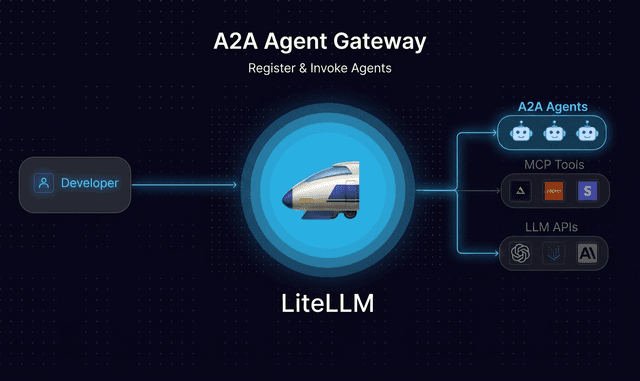
在 LiteLLM AI Gateway 中新增 A2A Agents,以 A2A Protocol 呼叫 agents,並在 LiteLLM Logs 中追蹤 request/response 記錄。管理哪些 Teams、Keys 可以存取哪些已上線的 Agents。
| 功能 | 支援 |
|---|---|
| 支援的 Agent 提供者 | A2A, Vertex AI Agent Engine, LangGraph, Azure AI Foundry, Bedrock AgentCore, Pydantic AI |
| 記錄 | ✅ |
| 負載平衡 | ✅ |
| 串流 | ✅ |
| Iteration Budgets | ✅ |
LiteLLM 依循 A2A (Agent-to-Agent) Protocol 來呼叫 agents。
新增您的 Agent
新增 A2A Agents
您可以透過 LiteLLM Admin UI 新增相容於 A2A 的 agents。
- 前往 Agents 分頁
- 點擊 Add Agent
- 輸入 agent 名稱(例如
ij-local)以及您的 A2A agent URL - 選擇 Protocol Version(
1.0或0.3)- LiteLLM 提供給該 agent 用戶端的線路格式
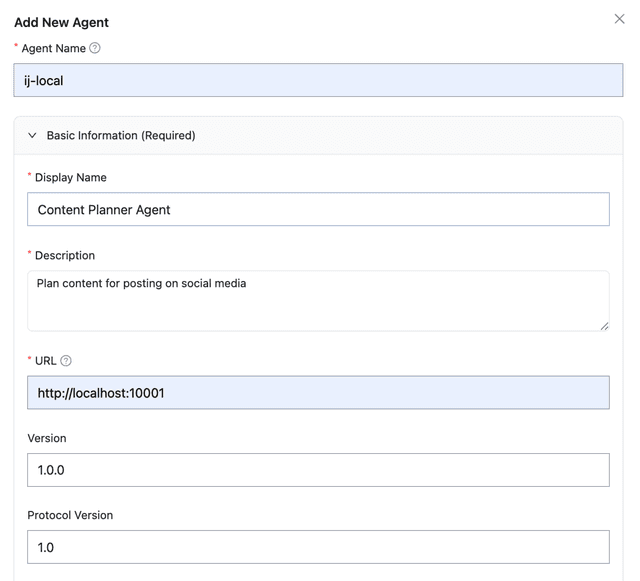
URL 應為您的 A2A agent 的呼叫 URL(例如 http://localhost:10001)。
透過 API 或設定註冊時,請在 agent_card_params 中設定 protocolVersion:
agents:
  - agent_name: my-agent
    agent_card_params:
      name: "My Agent"
      url: "http://localhost:10001"
      protocolVersion: "1.0"  # or "0.3"
新增 Azure AI Foundry Agents
請參考 這份指南,將您的 azure ai foundry agent 新增至 LiteLLM Agent Gateway
新增 Vertex AI Agent Engine
請參考 這份指南,將您的 Vertex AI Agent Engine 新增至 LiteLLM Agent Gateway
新增 Bedrock AgentCore Agents
請參考 這份指南,將您的 bedrock agentcore agent 新增至 LiteLLM Agent Gateway
新增 LangGraph Agents
請參考 這份指南以註冊 LangGraph agent 並設定其 agent card
新增 Pydantic AI Agents
請參考 這份指南,將您的 pydantic ai agent 新增至 LiteLLM Agent Gateway
Protocol 版本控管
LiteLLM proxy 會使用 a2a-sdk 1.x 路由 A2A agents,並可依每個 agent 對用戶端提供 A2A 0.3 或 1.0 的線路格式。上游 agents 可能使用任一版本;LiteLLM 會將 message/send、message/stream 以及延伸 card 的回應正規化為您鎖定的版本。
| 版本 | 線路格式 | 範例 send result |
|---|---|---|
| 0.3 | 依 kind 區分的物件(message、task、status-update、…) | {"kind": "message", "role": "user", "parts": [{"kind": "text", "text": "..."}]} |
| 1.0 | Protobuf JSON envelopes(message、task、statusUpdate、artifactUpdate) | {"message": {"role": "ROLE_USER", "parts": [{"text": "..."}]}} |
鎖定版本
在註冊 agent 時,將 agent_card_params.protocolVersion 設為 "0.3" 或 "1.0"(UI 下拉選單或 API)。LiteLLM 會在代理的 agent card 上提供該版本,並將上游回應轉換為相符格式。
僅接受 "0.3" 和 "1.0";其他值在註冊時會回傳 HTTP 400。
當 protocolVersion 未被鎖定時
如果 agent 沒有鎖定版本,LiteLLM 會根據用戶端請求推斷提供的版本:
| 用戶端訊號 | 提供的版本 |
|---|---|
JSON-RPC method SendMessage 或 SendStreamingMessage | 1.0 |
Request header a2a-version: 1.x | 1.0 |
否則(例如沒有 header 的 message/send) | 0.3 |
protocolVersion代理的 agent card 在未設定時預設為 1.0,但未帶 a2a-version header 的舊版 message/send 呼叫者會收到 0.3 形式的回應。請明確鎖定 protocolVersion,以確保您的 card 與回應永遠一致。
Task methods(tasks/get、tasks/list、…)會原封不動轉送至上游 agent。版本轉換僅適用於 LiteLLM 整合的 messaging 路徑。
相依性
LiteLLM proxy A2A 路由需要 a2a-sdk >= 1.1.0(包含於 proxy / proxy-dev 相依群組中)。如果您從自己的程式碼呼叫 agents,請安裝相對應的 SDK 版本:
pip install "a2a-sdk>=1.1.0,<2.0"
呼叫您的 Agents
請參考 呼叫 A2A Agents 指南,了解如何使用以下方式呼叫您的 agents:
- A2A SDK - 原生 A2A protocol,完整支援 tasks 和 artifacts
- OpenAI SDK - 熟悉的
/chat/completions介面,搭配a2a/model prefix
追蹤 Agent 記錄
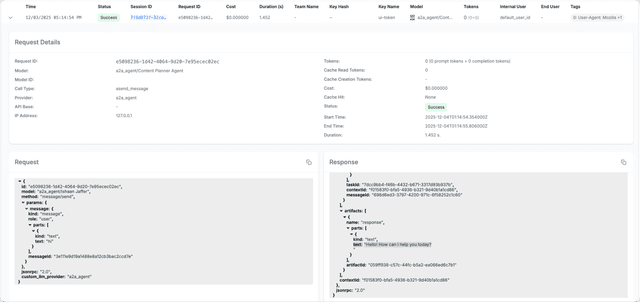
呼叫 agent 後,您可以在 LiteLLM 的 Logs 分頁查看 request 記錄。
記錄會顯示:
- 傳送給 agent 與從 agent 收到的 Request/Response content
- 進行追蹤的 User、Key、Team 資訊,顯示是哪個人發出的 request
- 延遲與成本 指標
轉送 LiteLLM Context Headers
當 LiteLLM 呼叫您的 A2A agent 時,會傳送特殊 headers 以啟用:
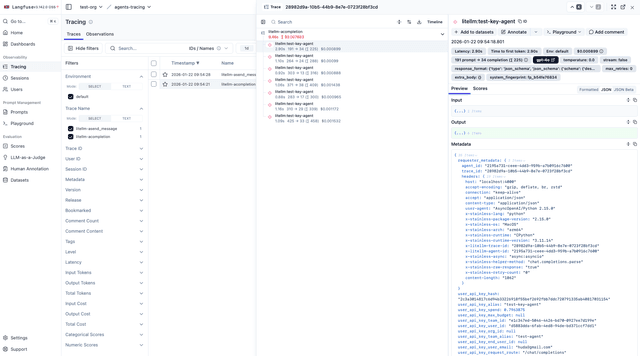
- Trace Grouping:來自同一次 agent 執行的所有 LLM calls 會顯示在同一條 trace 下
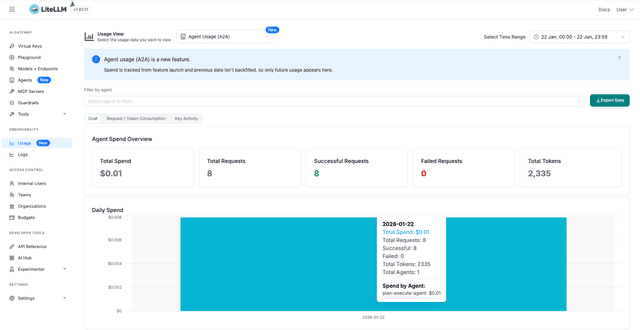
- Agent Spend Tracking:成本會歸屬到特定的 agent
| 標頭 | 用途 |
|---|---|
X-LiteLLM-Trace-Id | 將所有 LLM calls 連結到同一個執行流程 |
X-LiteLLM-Agent-Id | 將費用歸屬給正確的 agent |
若要啟用這些功能,您的 A2A server 必須將這些 headers 轉送 到其回呼至 LiteLLM 的任何 LLM calls。
實作步驟
步驟 1:從傳入的 A2A request 擷取 headers
    """Extract X-LiteLLM-* headers from incoming A2A request."""
    all_headers = request.call_context.state.get('headers', {})
    return {
        k: v for k, v in all_headers.items()
        if k.lower().startswith('x-litellm-')
    }
步驟 2:將 headers 轉送至您的 LLM calls 在回呼至 LiteLLM 時傳入已擷取的 headers:
- OpenAI SDK
- LangChain
- LiteLLM SDK
- HTTP (requests/httpx)
headers = get_litellm_headers(request)

client = OpenAI(
    api_key="sk-your-litellm-key",
    base_url="http://localhost:4000",
    default_headers=headers,  # Forward headers
)

response = client.chat.completions.create(
    model="gpt-4o",
    messages=[{"role": "user", "content": "Hello"}]
)
from langchain_openai import ChatOpenAI

headers = get_litellm_headers(request)

llm = ChatOpenAI(
    model="gpt-4o",
    openai_api_key="sk-your-litellm-key",
    base_url="http://localhost:4000",
    default_headers=headers,  # Forward headers
)
import litellm

headers = get_litellm_headers(request)

response = litellm.completion(
    model="gpt-4o",
    messages=[{"role": "user", "content": "Hello"}],
    api_base="http://localhost:4000",
    extra_headers=headers,  # Forward headers
)
import httpx

headers = get_litellm_headers(request)
headers["Authorization"] = "Bearer sk-your-litellm-key"

response = httpx.post(
    "http://localhost:4000/v1/chat/completions",
    headers=headers,
    json={"model": "gpt-4o", "messages": [{"role": "user", "content": "Hello"}]}
)
結果
啟用 header 轉送後,您會看到:
Langfuse 中的 Trace Grouping:
Agent 支出歸因:
API 參考
端點
| 端點 | 方法 | 用途 |
|---|---|---|
POST /a2a/{agent_id} | JSON-RPC 2.0 | 主要 — 所有 A2A methods(見下表) |
POST /a2a/{agent_id}/message/send | JSON-RPC | 僅 message/send 的別名 |
POST /v1/a2a/{agent_id}/message/send | JSON-RPC | 僅 message/send 的別名 |
GET /a2a/{agent_id}/.well-known/agent.json | Agent card | 探索(在 url 欄位中提供 proxy URL) |
GET /a2a/{agent_id}/.well-known/agent-card.json | Agent card | 探索(標準路徑) |
{agent_id} 可能是 agent UUID 或已註冊的 agent 名稱。
支援的 JSON-RPC methods
請將這些任一 method 傳送至 POST /a2a/{agent_id} 的 method 欄位:
| 方法 | 說明 |
|---|---|
message/send | 傳送訊息;回傳 task 或 message(LiteLLM 整合路徑) |
message/stream | 串流變體(NDJSON/SSE) |
tasks/get | 依 params.id 取得任務狀態 |
tasks/list | 列出任務(可選 params.contextId) |
tasks/cancel | 依 params.id 取消任務 |
tasks/resubscribe | 訂閱任務更新(串流) |
tasks/pushNotificationConfig/set | 註冊推播通知設定 |
tasks/pushNotificationConfig/get | 取得推播設定 |
tasks/pushNotificationConfig/list | 列出某任務的推播設定 |
tasks/pushNotificationConfig/delete | 刪除推播設定 |
agent/getAuthenticatedExtendedCard | 擴充代理程式卡片 |
路由: message/send 和 message/stream 會透過 LiteLLM 的 A2A 用戶端(記錄、防護欄、花費)。所有其他方法都會轉送至 agent_card_params.url 中的上游 URL。任務 API 需要該 URL;僅支援 completion bridge 的代理程式只支援訊息方法。
請參閱 支援的 A2A 方法 以查看範例、別名與限制。
驗證
請在兩個標頭其中之一中包含您的 LiteLLM Virtual Key — 當傳入的 Authorization 標頭可能攜帶要傳送給後端代理程式的權杖時,建議使用 x-litellm-api-key(例如,使用 依慣例的透傳 來轉送呼叫者的身分)。
Authorization: Bearer sk-your-litellm-key
# or
x-litellm-api-key: Bearer sk-your-litellm-key
每個代理程式的權限檢查
在虛擬金鑰通過驗證後,LiteLLM 會檢查呼叫的金鑰(及其團隊)是否允許呼叫所請求的代理程式。如果不允許,回應為 HTTP 403。完整的交集模型與存取群組請參閱 代理程式權限管理。
Trace ID 強制(選用,每個代理程式)
代理程式可以要求每個傳入請求都帶有 trace ID,以便進行跨系統稽核串接。請在代理程式的 litellm_params 中設定 require_trace_id_on_calls_to_agent: true。設定後,缺少 x-litellm-trace-id(或 x-litellm-session-id)的請求會以 HTTP 400 拒絕。
curl -X POST http://localhost:4000/v1/agents \
  -H "Authorization: Bearer sk-master-key" \
  -H "Content-Type: application/json" \
  -d '{
    "agent_name": "audit-critical-agent",
    "agent_card_params": { ... },
    "litellm_params": {
      "require_trace_id_on_calls_to_agent": true
    }
  }'
相反方向——強制由代理程式擁有的金鑰所發出的 outbound 呼叫必須帶有 trace ID——則由同一個 litellm_params 區塊中的 require_trace_id_on_calls_by_agent 控制。
子代理程式身分傳遞
當後端代理程式本身呼叫 LiteLLM(用於 chat completions 或呼叫子代理程式)時,LiteLLM 會轉送兩個標頭以維持 trace 的連續性:
X-LiteLLM-Trace-Id— 將鏈中的所有呼叫連結到單一 traceX-LiteLLM-Agent-Id— 將花費歸屬給原始代理程式
呼叫者的 virtual key 與 end-user ID 不會自動轉送。若下游代理程式需要使用者身分,請透過 extra_headers 或 x-a2a-{agent_name_or_id}-{header} 慣例 明確傳遞。
請求格式
LiteLLM 遵循 A2A JSON-RPC 2.0 規格。訊息本文結構取決於代理程式固定的 protocolVersion(若未固定,則取決於上方的用戶端訊號)。
- 0.3 wire format
- 1.0 wire format
{
  "jsonrpc": "2.0",
  "id": "unique-request-id",
  "method": "message/send",
  "params": {
    "message": {
      "role": "user",
      "parts": [{"kind": "text", "text": "Your message here"}],
      "messageId": "unique-message-id"
    }
  }
}
請使用 a2a-sdk 1.x 用戶端(建議)或在代理程式固定為 1.0 時,傳送帶有 PascalCase 方法/a2a-version: 1.0 標頭的 JSON-RPC。
// Build with a2a.types.Message, Part, Role, then wrap in SendMessageRequest
回應格式
- 0.3 response
- 1.0 response
{
  "jsonrpc": "2.0",
  "id": "unique-request-id",
  "result": {
    "kind": "task",
    "id": "task-id",
    "contextId": "context-id",
    "status": {"state": "completed", "timestamp": "2025-01-01T00:00:00Z"},
    "artifacts": [
      {
        "artifactId": "artifact-id",
        "name": "response",
        "parts": [{"kind": "text", "text": "Agent response here"}]
      }
    ]
  }
}
{
  "jsonrpc": "2.0",
  "id": "unique-request-id",
  "result": {
    "message": {
      "role": "ROLE_AGENT",
      "messageId": "msg-abc",
      "parts": [{"text": "Agent response here"}]
    }
  }
}
串流事件會使用 statusUpdate / artifactUpdate 鍵,而非 kind: "status-update"。
代理程式 JSON-RPC 錯誤會以與請求相同的 id(若可能)回傳在 error 欄位中。在 message/send 回傳 submitted 任務後,請使用 tasks/get 輪詢長時間執行的工作。
範例:tasks/get
curl -X POST "http://localhost:4000/a2a/my-agent" \
  -H "Authorization: Bearer sk-1234" \
  -H "Content-Type: application/json" \
  -d '{
    "jsonrpc": "2.0",
    "id": "req-2",
    "method": "tasks/get",
    "params": {"id": "task-id-from-send-response"}
  }'
代理程式登錄
想建立一個中央登錄,讓您的團隊可以發現公司內有哪些可用的代理程式嗎?
請使用 AI Hub 讓代理程式在整個組織內公開且可被發現。這可讓開發者瀏覽可用的代理程式,而不需要重新建置它們。