Langfuse
Langfuse 是什麼?
Langfuse(GitHub)是一個開源的 LLM 工程平台,用於模型 tracing、prompt 管理 與應用程式 評估。Langfuse 協助團隊協同除錯、分析與反覆迭代 LLM 應用程式。
使用 LiteLLM 透過多個模型在 Langfuse 中的範例 trace:
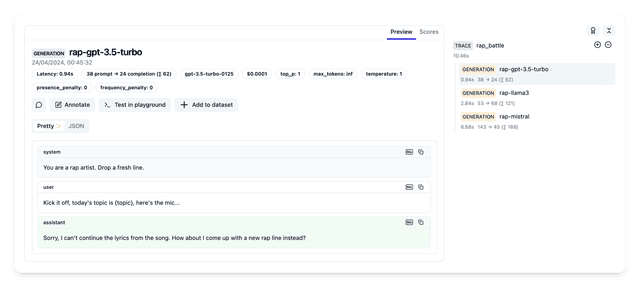
對於 Langfuse v3,我們建議在 OpenTelemetry v2 指南 中使用 langfuse_otel 預設值。
與 LiteLLM Proxy(LLM 閘道)搭配使用
👉 請透過此連結開始使用 LiteLLM Proxy server 將記錄傳送到 langfuse
與 LiteLLM Python SDK 搭配使用
先決條件
請先執行 uv add langfuse 以完成此整合
uv add langfuse==2.59.7 litellm
快速開始
只需 2 行程式碼,即可透過 Langfuse 立即記錄您的回應,涵蓋所有提供者:

請從 https://cloud.langfuse.com/ 取得您的 Langfuse API 金鑰
litellm.success_callback = ["langfuse"]
litellm.failure_callback = ["langfuse"] # logs errors to langfuse
# uv add langfuse
import litellm
import os

# from https://cloud.langfuse.com/
os.environ["LANGFUSE_PUBLIC_KEY"] = ""
os.environ["LANGFUSE_SECRET_KEY"] = ""
# Optional, defaults to https://cloud.langfuse.com
os.environ["LANGFUSE_HOST"] # optional

# LLM API Keys
os.environ['OPENAI_API_KEY']=""

# set langfuse as a callback, litellm will send the data to langfuse
litellm.success_callback = ["langfuse"]

# openai call
response = litellm.completion(
  model="gpt-3.5-turbo",
  messages=[
    {"role": "user", "content": "Hi 👋 - i'm openai"}
  ]
)
進階
設定自訂生成名稱、傳遞中繼資料
在 metadata 中傳遞 generation_name
import litellm
from litellm import completion
import os

# from https://cloud.langfuse.com/
os.environ["LANGFUSE_PUBLIC_KEY"] = "pk-..."
os.environ["LANGFUSE_SECRET_KEY"] = "sk-..."


# OpenAI and Cohere keys
# You can use any of the litellm supported providers: https://docs.litellm.ai/docs/providers
os.environ['OPENAI_API_KEY']="sk-..."

# set langfuse as a callback, litellm will send the data to langfuse
litellm.success_callback = ["langfuse"]

# openai call
response = completion(
  model="gpt-3.5-turbo",
  messages=[
    {"role": "user", "content": "Hi 👋 - i'm openai"}
  ],
  metadata = {
    "generation_name": "litellm-ishaan-gen", # set langfuse generation name
    # custom metadata fields
    "project": "litellm-proxy"
  }
)

print(response)
設定自訂 Trace ID、Trace User ID、Trace Metadata、Trace Version、Trace Release 與 Tags
在 metadata 中傳遞 trace_id、trace_user_id、trace_metadata、trace_version、trace_release、tags
import litellm
from litellm import completion
import os

# from https://cloud.langfuse.com/
os.environ["LANGFUSE_PUBLIC_KEY"] = "pk-..."
os.environ["LANGFUSE_SECRET_KEY"] = "sk-..."

os.environ['OPENAI_API_KEY']="sk-..."

# set langfuse as a callback, litellm will send the data to langfuse
litellm.success_callback = ["langfuse"]

# set custom langfuse trace params and generation params
response = completion(
  model="gpt-3.5-turbo",
  messages=[
    {"role": "user", "content": "Hi 👋 - i'm openai"}
  ],
  metadata={
      "generation_name": "ishaan-test-generation",  # set langfuse Generation Name
      "generation_id": "gen-id22",                  # set langfuse Generation ID
      "parent_observation_id": "obs-id9"            # set langfuse Parent Observation ID
      "version":  "test-generation-version"         # set langfuse Generation Version
      "trace_user_id": "user-id2",                  # set langfuse Trace User ID
      "session_id": "session-1",                    # set langfuse Session ID
      "tags": ["tag1", "tag2"],                     # set langfuse Tags
      "trace_name": "new-trace-name"                # set langfuse Trace Name
      "trace_id": "trace-id22",                     # set langfuse Trace ID
      "trace_metadata": {"key": "value"},           # set langfuse Trace Metadata
      "trace_version": "test-trace-version",        # set langfuse Trace Version (if not set, defaults to Generation Version)
      "trace_release": "test-trace-release",        # set langfuse Trace Release
      ### OR ###
      "existing_trace_id": "trace-id22",            # if generation is continuation of past trace. This prevents default behaviour of setting a trace name
      ### OR enforce that certain fields are trace overwritten in the trace during the continuation ###
      "existing_trace_id": "trace-id22",
      "trace_metadata": {"key": "updated_trace_value"},            # The new value to use for the langfuse Trace Metadata
      "update_trace_keys": ["input", "output", "trace_metadata"],  # Updates the trace input & output to be this generations input & output also updates the Trace Metadata to match the passed in value
      "debug_langfuse": True,                                      # Will log the exact metadata sent to litellm for the trace/generation as `metadata_passed_to_litellm`
  },
)

print(response)
您也可以將 metadata 作為請求標頭的一部分傳遞,並加上 langfuse_* 前綴:
curl --location --request POST 'http://0.0.0.0:4000/chat/completions' \
    --header 'Content-Type: application/json' \
    --header 'Authorization: Bearer sk-1234' \
    --header 'langfuse_trace_id: trace-id2' \
    --header 'langfuse_trace_user_id: user-id2' \
    --header 'langfuse_trace_metadata: {"key":"value"}' \
    --data '{
    "model": "gpt-3.5-turbo",
    "messages": [
        {
        "role": "user",
        "content": "what llm are you"
        }
    ]
}'
Trace 與生成參數
Trace 特定參數
trace_id- trace 的識別碼;若這是既有 trace,則必須使用existing_trace_id取代trace_id;預設為自動產生trace_name- trace 的名稱;預設為自動產生session_id- trace 的 session 識別碼;預設為Nonetrace_version- trace 的版本;預設為version的值trace_release- trace 的 release;預設為Nonetrace_metadata- trace 的中繼資料;預設為Nonetrace_user_id- trace 的使用者識別碼;預設為 completion 引數usertags- trace 的標籤;預設為None
續接時可更新的參數
以下參數可在 trace 的續接中更新,方法是將下列值傳入 completion 的中繼資料中的 update_trace_keys。
input- 會將 trace 的輸入設為此最新生成的輸入output- 會將 trace 的輸出設為此生成的輸出trace_version- 會將 trace 版本設為所提供的值(若要改用最新生成的版本,請使用version)trace_release- 會將 trace release 設為所提供的值trace_metadata- 會將 trace 中繼資料設為所提供的值trace_user_id- 會將 trace 使用者 ID 設為所提供的值
生成特定參數
generation_id- 生成的識別碼;預設為自動產生generation_name- 生成的識別碼;預設為自動產生parent_observation_id- 上層觀測的識別碼;預設為Noneprompt- 生成所使用的 Langfuse prompt 物件;預設為None
傳入 @litellm completion 的中繼資料中未列於上述規格的任何其他鍵值對,都會作為生成的中繼資料鍵值對加入。
多個 Langfuse 專案(每次請求的憑證)
您可以透過直接傳遞憑證給 completion() 或 acompletion(),將 trace 依每次請求傳送到不同的 Langfuse 專案。這可與全域環境變數一起使用(或取而代之),當不同團隊或業務流程使用不同的 Langfuse 專案時特別有用。
將 langfuse_public_key、langfuse_secret_key(或 langfuse_secret),以及可選的 langfuse_host 作為關鍵字引數傳遞:
import litellm
from litellm import completion

# Optional: set a default via env for requests that don't pass credentials
# os.environ["LANGFUSE_PUBLIC_KEY"] = "pk-default..."
# os.environ["LANGFUSE_SECRET_KEY"] = "sk-default..."

litellm.success_callback = ["langfuse"]
litellm.failure_callback = ["langfuse"]

# Request 1 → Langfuse Project A
response_a = completion(
    model="gpt-3.5-turbo",
    messages=[{"role": "user", "content": "Hello from team A"}],
    langfuse_public_key="pk-lf-project-a...",
    langfuse_secret_key="sk-lf-project-a...",
    langfuse_host="https://us.cloud.langfuse.com",  # optional
)

# Request 2 → Langfuse Project B (different project)
response_b = completion(
    model="gpt-3.5-turbo",
    messages=[{"role": "user", "content": "Hello from team B"}],
    langfuse_public_key="pk-lf-project-b...",
    langfuse_secret_key="sk-lf-project-b...",
    langfuse_host="https://eu.cloud.langfuse.com",  # optional, can differ per project
)
使用每次請求憑證的非同步用法:
import litellm
from litellm import acompletion

litellm.success_callback = ["langfuse"]
litellm.failure_callback = ["langfuse"]

response = await acompletion(
    model="gpt-3.5-turbo",
    messages=[{"role": "user", "content": "Hi"}],
    langfuse_public_key="pk-lf-...",
    langfuse_secret_key="sk-lf-...",
    langfuse_host="https://us.cloud.langfuse.com",  # optional
)
langfuse_public_key– Langfuse 專案公開金鑰(每次請求覆寫所需)。langfuse_secret_key或langfuse_secret– Langfuse 私密金鑰(兩種名稱皆可接受)。langfuse_host– Langfuse 主機 URL(例如https://us.cloud.langfuse.com);可選,預設為環境變數或 Langfuse cloud。
當傳入這些值時,該請求會使用此專案(以及主機)進行 Langfuse callback;若未提供,callback 會使用全域 Langfuse client(若已設定,則來自環境變數)。LiteLLM 會針對每組憑證快取一個 Langfuse client,以避免每次請求都建立新的 client。
停用記錄 - 特定呼叫
若要停用特定呼叫的記錄,請使用 no-log 標記。
completion(messages = ..., model = ..., **{"no-log": True})
搭配使用 LangChain ChatLiteLLM + Langfuse
在 model_kwargs 中傳遞 trace_user_id、session_id
import os
from langchain.chat_models import ChatLiteLLM
from langchain.schema import HumanMessage
import litellm

# from https://cloud.langfuse.com/
os.environ["LANGFUSE_PUBLIC_KEY"] = "pk-..."
os.environ["LANGFUSE_SECRET_KEY"] = "sk-..."

os.environ['OPENAI_API_KEY']="sk-..."

# set langfuse as a callback, litellm will send the data to langfuse
litellm.success_callback = ["langfuse"]

chat = ChatLiteLLM(
  model="gpt-3.5-turbo"
  model_kwargs={
      "metadata": {
        "trace_user_id": "user-id2", # set langfuse Trace User ID
        "session_id": "session-1" ,  # set langfuse Session ID
        "tags": ["tag1", "tag2"]
      }
    }
  )
messages = [
    HumanMessage(
        content="what model are you"
    )
]
chat(messages)
從 Langfuse 記錄中遮罩訊息、回應內容
從所有 Langfuse 記錄中遮罩訊息與回應
設定 litellm.turn_off_message_logging=True 這將防止訊息與回應被記錄到 langfuse,但請求中繼資料仍會被記錄。
從特定 Langfuse 記錄中遮罩訊息與回應
在通常為文字 completion 或 embedding 呼叫所傳遞的中繼資料中,您可以設定特定鍵值來遮罩此呼叫的訊息與回應。
將 mask_input 設為 True,會遮罩此呼叫的輸入不被記錄
將 mask_output 設為 True,會使此呼叫的輸出不被記錄。
請注意,若您正在續接既有 trace,且將 update_trace_keys 設為包含 input 或 output,並且您設定對應的 mask_input 或 mask_output,那麼該 trace 既有的輸入和/或輸出將會被替換為已遮罩的訊息。
疑難排解與錯誤
資料沒有被記錄到 Langfuse?
- 請確認您使用的是最新版本的 langfuse
uv add langfuse -U。最新版本可讓 litellm 將 JSON 輸入/輸出記錄到 langfuse - 如果您在 langfuse 中看不到任何 trace,請遵循 此檢查清單。
支援與創辦人交流
- 預約 Demo 👋
- 社群 Discord 💭
- 我們的電子郵件 ✉️ ishaan@berri.ai / krrish@berri.ai