自動注入提示快取檢查點
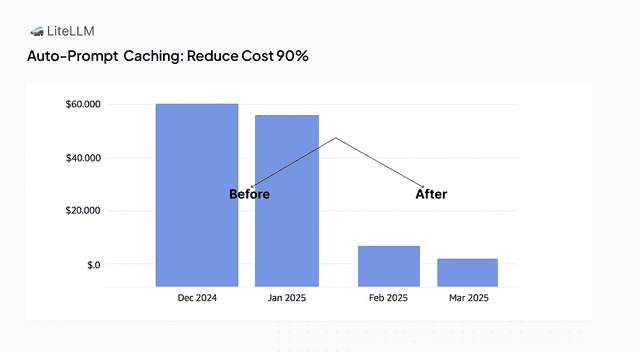
透過使用 LiteLLM 自動注入提示快取檢查點,最多可將成本降低 90%。
支援的提供者(cache_control 標記):
- Anthropic API (
anthropic/) - AWS Bedrock - Claude (
bedrock/) - Vertex AI - Claude and Gemini (
vertex_ai/) - Google AI Studio - Gemini (
gemini/) - Azure AI - Claude (
azure_ai/) - OpenRouter - Claude, Gemini, MiniMax, GLM, z-ai routes (
openrouter/) - Databricks - Claude (
databricks/) - DashScope / Qwen (
dashscope/) - MiniMax (
minimax/) - Z.ai / GLM (
zai/)
提供者代管(自動,無需標記):
- OpenAI (
openai/) - DeepSeek (
deepseek/) - xAI (
xai/)
運作方式
LiteLLM 可自動將提示快取檢查點注入到您對 LLM 提供者的請求中。這可帶來:
- 降低成本:提示中長且靜態的部分可被快取,以避免重複處理
- 無需修改應用程式程式碼:您可以在 LiteLLM UI 或
litellm config.yaml檔案中設定自動快取行為。
設定
您需要在模型設定中指定 cache_control_injection_points。這會告訴 LiteLLM:
- 要在哪裡加入快取指令(
location) - 要針對哪則訊息(
role)
接著,LiteLLM 會自動將 cache_control 指令加入您請求中指定的訊息:
"cache_control": {
    "type": "ephemeral"
}
LiteLLM Python SDK 使用方式
在您的 completion 呼叫中使用 cache_control_injection_points 參數,即可自動注入快取指令。
基本範例 - 快取系統訊息
from litellm import completion
import os

os.environ["ANTHROPIC_API_KEY"] = ""

response = completion(
    model="anthropic/claude-3-5-sonnet-20240620",
    messages=[
        {
            "role": "system",
            "content": [
                {
                    "type": "text",
                    "text": "You are an AI assistant tasked with analyzing legal documents.",
                },
                {
                    "type": "text",
                    "text": "Here is the full text of a complex legal agreement" * 400,
                },
            ],
        },
        {
            "role": "user",
            "content": "what are the key terms and conditions in this agreement?",
        },
    ],
    # Auto-inject cache control to system messages
    cache_control_injection_points=[
        {
            "location": "message",
            "role": "system",
        }
    ],
)

print(response.usage)
重點:
- 使用
cache_control_injection_points參數指定要注入快取的位置 location: "message"目標為對話中的訊息role: "system"目標為所有系統訊息- LiteLLM 會自動將
cache_control加入符合條件訊息的最後一個內容區塊(依 Anthropic 的 API 規格)
LiteLLM 修改後的請求:
LiteLLM 會自動將您的請求轉換為,在系統訊息的最後一個內容區塊加入 cache_control:
{
    "messages": [
        {
            "role": "system",
            "content": [
                {
                    "type": "text",
                    "text": "You are an AI assistant tasked with analyzing legal documents."
                },
                {
                    "type": "text",
                    "text": "Here is the full text of a complex legal agreement...",
                    "cache_control": {"type": "ephemeral"}  // Added by LiteLLM
                }
            ]
        },
        {
            "role": "user",
            "content": "what are the key terms and conditions in this agreement?"
        }
    ]
}
依索引指定特定訊息
您可以依 messages 陣列中的索引來指定特定訊息。使用負索引可從尾端開始指定。
from litellm import completion
import os

os.environ["ANTHROPIC_API_KEY"] = ""

response = completion(
    model="anthropic/claude-3-5-sonnet-20240620",
    messages=[
        {
            "role": "user",
            "content": "First message",
        },
        {
            "role": "assistant",
            "content": "Response to first",
        },
        {
            "role": "user",
            "content": [
                {"type": "text", "text": "Here is a long document to analyze:"},
                {"type": "text", "text": "Document content..." * 500},
            ],
        },
    ],
    # Target the last message (index -1)
    cache_control_injection_points=[
        {
            "location": "message",
            "index": -1,  # -1 targets the last message, -2 would target second-to-last, etc.
        }
    ],
)

print(response.usage)
重要說明:
- 當一則訊息有多個內容區塊(例如圖片或多個文字區塊)時,
cache_control只會加入到最後一個內容區塊 - 這遵循 Anthropic 的 API 規格,其要求:「當使用多個內容區塊時,只有最後一個內容區塊可以有 cache_control」
- Anthropic 每個請求最多可有 4 個帶有
cache_control的區塊
LiteLLM 修改後的請求:
LiteLLM 會將 cache_control 加入目標訊息的最後一個內容區塊(index -1 = 最後一則訊息):
{
    "messages": [
        {
            "role": "user",
            "content": "First message"
        },
        {
            "role": "assistant",
            "content": "Response to first"
        },
        {
            "role": "user",
            "content": [
                {
                    "type": "text",
                    "text": "Here is a long document to analyze:"
                },
                {
                    "type": "text",
                    "text": "Document content...",
                    "cache_control": {"type": "ephemeral"}  // Added by LiteLLM to last content block only
                }
            ]
        }
    ]
}
LiteLLM Proxy 使用方式
您可以在 proxy 設定檔中設定 cache control 注入。
- litellm config.yaml
- LiteLLM UI
model_list:
  - model_name: anthropic-auto-inject-cache-system-message
    litellm_params:
      model: anthropic/claude-3-5-sonnet-20240620
      api_key: os.environ/ANTHROPIC_API_KEY
      cache_control_injection_points:
        - location: message
          role: system
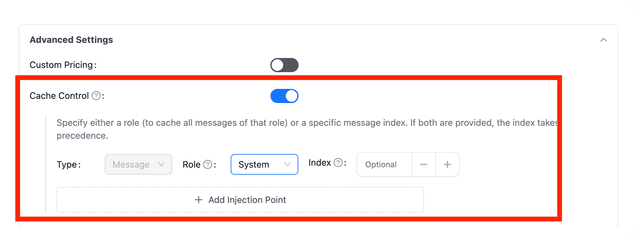
在 LiteLLM UI 上,您可以在新增模型時於 Advanced Settings 分頁中指定 cache_control_injection_points。
詳細範例
1. 傳送至 LiteLLM 的原始請求
在這個範例中,我們有一段非常長且靜態的 system message,以及一段變動的 user message。由於 system message 幾乎不會變更,因此將其快取會更有效率。
{
    "messages": [
        {
            "role": "system",
            "content": [
                {
                    "type": "text",
                    "text": "You are a helpful assistant. This is a set of very long instructions that you will follow. Here is a legal document that you will use to answer the user's question."
                }
            ]
        },
        {
            "role": "user",
            "content": [
                {
                    "type": "text",
                    "text": "What is the main topic of this legal document?"
                }
            ]
        }
    ]
}
2. LiteLLM 修改後的請求
LiteLLM 會根據我們的設定,自動將快取指令注入 system message:
{
    "messages": [
        {
            "role": "system",
            "content": [
                {
                    "type": "text",
                    "text": "You are a helpful assistant. This is a set of very long instructions that you will follow. Here is a legal document that you will use to answer the user's question.",
                    "cache_control": {"type": "ephemeral"}
                }
            ]
        },
        {
            "role": "user",
            "content": [
                {
                    "type": "text",
                    "text": "What is the main topic of this legal document?"
                }
            ]
        }
    ]
}
當模型提供者處理這個請求時,會辨識快取指令,並且只處理一次 system message,將其快取供後續請求使用。
相關文件
- 手動提示快取 - 了解如何手動將
cache_control指令加入您的訊息